
Dis • Ease
An honest, compassionate conversation about why so many of us are unwell, and what the body has been waiting for us to understand.
Growing Place Chico does not prescribe diets or medical treatments. This document is offered for educational purposes only.
A WORD BEFORE WE BEGIN
This is not a medical document. It carries no condemnation, no judgment, and no agenda other than this: you deserve to understand what is happening in your body, and why.
Most of us were never taught how the body actually works. We were taught to go to the doctor when something goes wrong, take what we were prescribed, and trust the process. What if there’s more to that journey than just a diagnosis, a prescription, and a pill?
What follows is an honest conversation. It may challenge some of what we’ve been told. It is offered with deep respect for how hard life is, and with a genuine belief that the human body, given half a chance, is the most extraordinary healing instrument ever designed. That is not a small thing to understand. In fact, it changes everything.
You are not broken.
Your body is responding – rationally – to the (irrational) environment it has been placed in.
CHAPTER ONE: THE WORD ITSELF
Dis • Ease
Say it slowly. Dis • Ease.
Not disease as in a random misfortune that arrives uninvited. But Dis • Ease. The absence of ease. The state of a body, mind, and spirit that has been deprived, for too long, of the conditions it was designed to thrive in. The word itself contains the very diagnosis.
When we are not at rest; When our relationships are fractured or toxic; When our food is engineered rather than grown; When our days are driven by anxiety and our nights are cut short; When our inner life is running on empty – the body registers every bit of it down to the very cellular level. And eventually, it speaks.
We call what it says by many names: high blood pressure, anxiety, fear, depression, diabetes, autoimmune disease, chronic fatigue, obesity, cancer, heart disease... We treat them as separate conditions requiring separate solutions. But most of the time, they are the same message delivered through different doors.
The body is not attacking you. It is reporting to you.
The question is whether we are willing to listen.
When did you last feel genuinely well? not just functional,
but truly at ease in your body, soul, and spirit?
What would it mean to you if the symptoms you are living with were not permanent fixtures,
but signals pointing toward something that could actually change?
CHAPTER TWO: WHAT WE HAVE DONE TO OURSELVES
The Honest Picture
We have built a world that is, in many ways, profoundly hostile to human health. Not through malice or ill intent, but through distraction, convenience, and a slow drift away from the conditions our bodies were designed for. Here is what that looks like in practice.
Ultra-Processed Foods & Fluids
More than 70% of the American diet is now composed of food that has been engineered in a laboratory. It’s been stripped of natural nutrients, loaded with industrial seed oils, refined sugars, artificial additives, and flavor compounds designed to override the body's natural signals.
This is not food in any traditional sense. It is a product. And its effects on the gut lining, the microbiome, the immune system, and the brain are profound, measurable, and cumulative. The gut is often called the second brain. And when it is chronically inflamed, the entire system pays the price.
What does your daily diet actually consist of?
How much of it comes from a package, a drive-through window, or a box?
What if the fatigue, the brain fog, the mood swings, and the extra weight were not character flaws – but predictable biological responses to what you have been eating and drinking?
Sleep – The Missed Repair Cycle
Every night of deep, restorative sleep is a full-body repair cycle. The brain runs its glymphatic system (its biological waste management), clearing neurotoxic debris that accumulates during waking hours. The immune system resets. Hormones rebalance, and cellular repair begins.
Chronic sleep deprivation, even modest sustained sleep loss, elevates cortisol, disrupts insulin regulation, suppresses immune function, accelerates cellular aging, and increases the risk of virtually every chronic disease we have named. We have built a culture that treats sleep as optional, and the body disagrees. Emphatically!
How many hours of genuinely restorative sleep are you getting?
What is it costing you to run on less than you need?
A Body That Was Made to Move
The human body was not designed for a chair. For thousands of years, our ancestors moved daily, purposefully, and variably. Movement isn’t punishment. It’s biology. It directly stimulates the production of BDNF, the brain's growth factor, and is one of the most powerful antidepressants, anti-anxiety agents, and cellular repair mechanisms we have ever identified.
Sedentary behavior starves the mitochondria, the little energy factories of every cell. It allows inflammatory molecules to accumulate unchecked. It suppresses the very systems that keep us well. And it’s now the default setting for most American children, youth, and adults.
What would it look like to move your body today – not as a performance, but as an act of care?
Stress – The Silent Architect
Chronic psychological stress is not a feeling. It’s a physiological state. When the stress response is activated repeatedly and never fully resolved – through unresolved trauma, relational dysfunction, financial pressure, social isolation, or simply the relentless pace of modern life – the body's HPA axis remains in a state of sustained activation.
Cortisol stays elevated. The immune system is suppressed. The gut lining becomes permeable. The thyroid is disrupted. The brain's hippocampus, critical to memory and emotion regulation, literally shrinks under prolonged cortisol exposure. This is not metaphor. This is measurable biology.
What chronic stressors are you carrying that have never been fully addressed?
What is the cumulative cost of that weight on your body and mind?
Connection, Nature & Purpose
We were not designed to live in isolation, disconnected from the natural world, without a sense of belonging, meaning or purpose. These are not luxuries. They are, by design, biological necessities. Loneliness elevates inflammatory markers equivalent to smoking fifteen cigarettes a day.
Time in nature measurably reduces cortisol, improves immune function, and regulates our nervous system. Purpose, a reason to get up in the morning, is one of the strongest predictors of longevity across every culture studied.
We have built a world of unprecedented connectivity and unprecedented loneliness simultaneously – and the body notices.
Where in your life do you experience genuine connection – to other people, to the natural world,
to something or someone larger than yourself?
CHAPTER THREE: THE REPORT CARD
What We Do With the Signal
Most all of us have been conditioned to outsource our health. To a pill, to a procedure, to a professional. The idea that the body is capable of healing itself when given the right conditions has been systematically deprioritized in favor of interventions that are billable, repeatable, and often passive for the patient.
This is not a conspiracy. It is an incentive structure. And it produces a predictable pattern.
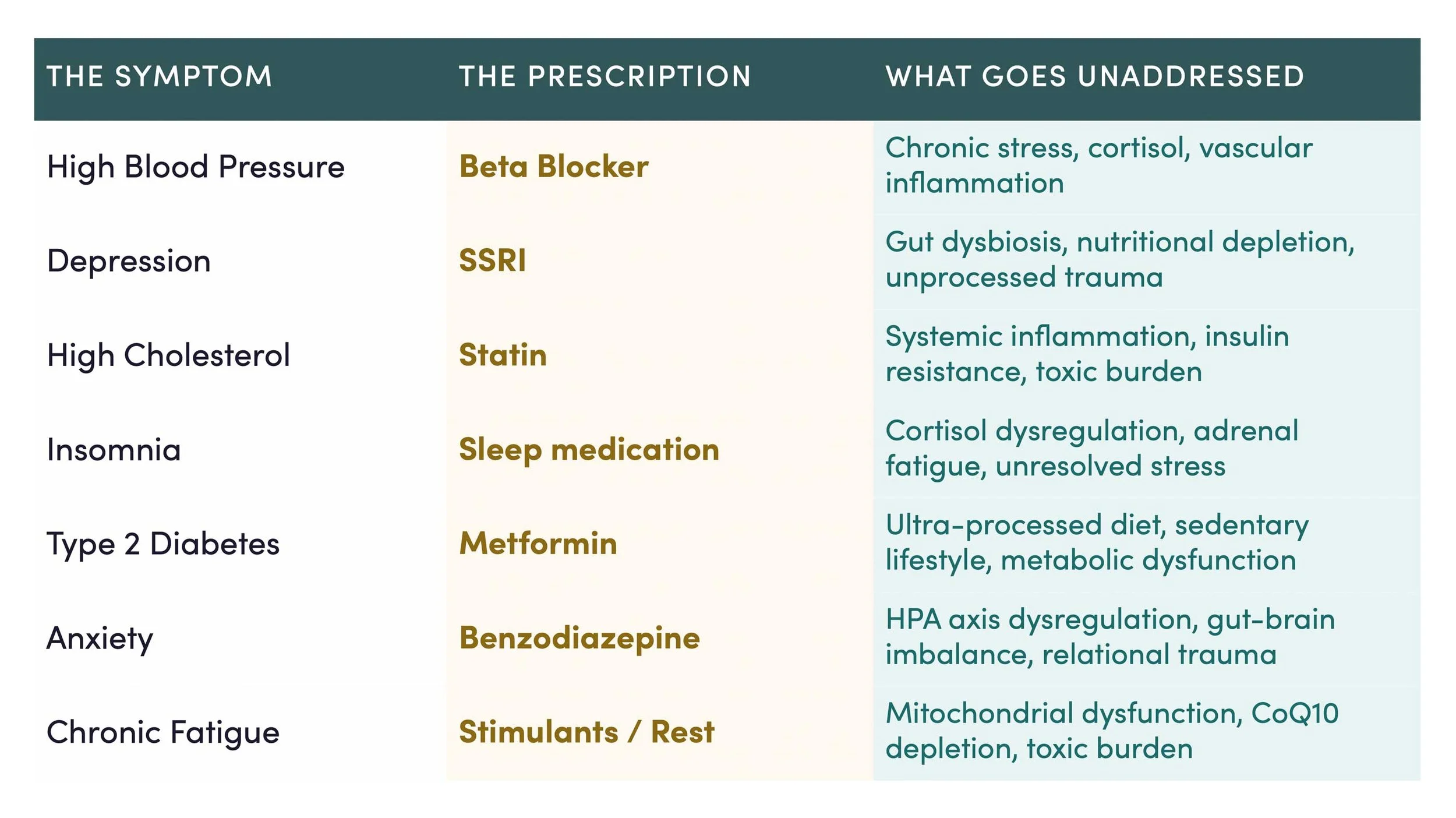
The pattern goes like this: The body keeps sending the signal; The system keeps silencing the alarm; The root cause compounds; The prescription list grows; The patient deteriorates more slowly; And that, gets recorded as a treatment success.
The road to Dis • Ease is not paved with bad luck. It is paved with unaddressed root causes – and a system that has little financial incentive to resolve them.
How many medications are you currently taking?
do you know what root causes they are managing rather than resolving?
What would it mean to you to address the source of the signal rather than silence it?
CHAPTER FOUR: WHAT THE BODY HAS ALWAYS KNOWN
The Conditions for Healing
Here is what isn’t complicated, even though the system may have made it feel that way:
The human body is a self-healing, self-regulating instrument of extraordinary design. It’s been doing this for thousands of years, without a pharmacy, without a diagnosis code, and without a managed health-care plan. Every major system it contains: the immune, endocrine, neurological, cardiovascular, gastrointestinal systems, have built-in, intertwined repair mechanisms that function beautifully when given the right inputs and protected from chronic assault.
Healing is not a mystery. It’s a return. A return to the conditions the body was designed for.
Real Food
Not a product. Not engineered for shelf life and profit. Real food, grown from the earth, is a language the body already knows and understands. It’s rich in the nutrients required for cellular repair, neurotransmitter synthesis, hormone production, and immune function. The gut microbiome – the ecosystem of trillions of micro-organisms that govern mood, immunity, and inflammation – responds within days to dietary change. This isn’t a slow process. The body moves fast when given what it needs.
Protected Sleep
Not optimized or hacked, but intentionally protected. Seven to nine hours of uninterrupted, dark, cool sleep is a biological requirement – not a lifestyle preference. It’s the window during which the body does the work that waking life can’t. Prioritizing it isn’t laziness. It’s one of the most health-generating decisions a person can make.
Intentional Movement
Daily. Varied. Purposeful. Not punishment, but intentional participation. Activities like walking in nature, lifting, stretching, playing, biking, dancing, swimming… The form matters far less than the consistency. Movement is the single intervention that touches the most healing mechanisms simultaneously. It is free, requires no prescription, and produces no side effects other than feeling better.
Emotional & Relational Health
Unresolved trauma, chronic relational stress, and the absence of genuine connection are not psychological abstractions. They alter our very gene expression. They suppress immune function. They accelerate cellular aging. Healing the inner life isn’t separate from healing the body. It’s the same mission.
Nature & Stillness
Time in the natural world measurably reduces cortisol, restores attention, improves immune function, and regulates the nervous system. Stillness, that genuine, quiet inner rest, activates the parasympathetic state that is the biological prerequisite for cellular repair. You cannot heal what you cannot rest. This is not inspirational language. It is physiology.
The parasympathetic state is not a reward for productivity.
It is the biological prerequisite for healing.
CHAPTER FIVE: AN INVITATION
Not a Program. An Intentional Direction.
Nobody arrives at Dis • Ease overnight. And nobody reverses it overnight either. What changes first is understanding. And then, one decision at a time, direction.
This conversation is not asking you to overhaul your life by next Tuesday. It is asking a simpler question:
What if your body was not your enemy…
but the most faithful messenger you have ever had?
What if the fatigue, the pain, the weight, the anxiety, the sleeplessness were not random misfortunes or genetic fate, but coherent, honest signals from a system that’s been carrying too much, for too long, with too little of what it actually needs?
Many people are living in Dis • Ease for no other reason than they have never been told any of this. Not because they lack the discipline, willpower or even the desire to be well. But because the conversation was never had.
This is that conversation. And it begins wherever you are.
Some Questions Worth Sitting With
What is one thing in my daily environment – food, fluids, sleep, movement, stress, relationship – that I already know is working against my body?
What would change in my life if I had more energy, more clarity, and more lasting ease in my body?
Who in my life could walk this road with me – not as a critic, but as a companion?
What is one small, honest step I could take this week toward the conditions my body was designed for?
There are no perfect answers. There is no single protocol. There is only the direction – and the willingness and courage to begin moving in it.
The body is patient. It has been waiting. And it responds to even small acts of genuine care with a generosity that will surprise you.
A Note on Research Consensus vs. Cited Studies
Several claims in Dis • Ease reflect broad, well-established research consensus rather than a single citable study. These include: the role of the parasympathetic nervous system in cellular repair, mitochondrial function and sedentary behavior, the bi-directionality of the gut-immune axis, and the general relationship between chronic cortisol elevation and systemic inflammation. These are presented in the text as established physiological principles rather than attributed to individual studies, consistent with their status in the biomedical literature.
The following references support the evidence-based claims in Dis • Ease. Where broad research consensus is referenced in the text, it is noted as such below. Where meta-analyses are cited, they are explicitly identified. Where research is emerging or contested, it is flagged accordingly.
CHAPTER TWO — ULTRA-PROCESSED FOOD & THE GUT-BRAIN AXIS
Cryan, J. F., O'Riordan, K. J., Cowan, C. S. M., Sandhu, K. V., Bastiaanssen, T. F. S., Boehme, M., Codagnone, M. G., Cussotto, S., Fulling, C., Golubeva, A. V., Guzzetta, K. E., Jaggar, M., Long-Smith, C. M., Lyte, J. M., Martin, J. A., Molinero-Perez, A., Moloney, G., Morelli, E., Morillas, E., … Dinan, T. G. (2019). The microbiota-gut-brain axis. Physiological Reviews, 99(4), 1877–2013. https://doi.org/10.1152/physrev.00018.2018
Seminal review establishing the bidirectional gut-brain communication axis. Primary basis for 'the gut is the second brain' framing throughout the document.
Hall, K. D., Ayuketah, A., Brychta, R., Cai, H., Cassimatis, T., Chen, K. Y., Chung, S. T., Costa, E., Courville, A., Darcey, V., Fletcher, L. A., Forde, C. G., Gharib, A. M., Guo, J., Howard, R., Joseph, P. V., McGehee, S., Ouwerkerk, R., Raisinger, K., … Zhou, M. (2019). Ultra-processed diets cause excess calorie intake and weight gain: An inpatient randomized controlled trial of ad libitum food intake. Cell Metabolism, 30(1), 67–77.e3. https://doi.org/10.1016/j.cmet.2019.05.008
NIH randomized controlled trial — the most rigorous evidence that ultra-processed diets drive excess caloric intake independent of macronutrient content.
Wastyk, H. C., Fragiadakis, G. K., Perelman, D., Dahl, W. J., Zhu, Z., Sonnenburg, J. L., & Gardner, C. D. (2021). Gut-microbiota-targeted diets modulate human immune status. Cell, 184(16), 4137–4153.e14. https://doi.org/10.1016/j.cell.2021.06.019
Stanford/Sonnenburg Lab RCT: high-fermented food diet increased microbiome diversity and reduced 19 inflammatory proteins within 10 weeks. Basis for microbiome responsiveness claims.
Fiolet, T., Srour, B., Sellem, L., Kesse-Guyot, E., Allès, B., Méjean, C., Deschasaux, M., Fassier, P., Latino-Martel, P., Beslay, M., Hercberg, S., Lavalette, C., Monteiro, C. A., Julia, C., & Touvier, M. (2018). Consumption of ultra-processed foods and cancer risk: Results from NutriNet-Santé prospective cohort. BMJ, 360, k322. https://doi.org/10.1136/bmj.k322
Large prospective cohort study linking UPF consumption to elevated cancer risk.
CHAPTER TWO — SLEEP: THE MISSED REPAIR CYCLE
Xie, L., Kang, H., Xu, Q., Chen, M. J., Liao, Y., Thiyagarajan, M., O'Donnell, J., Christensen, D. J., Nicholson, C., Iliff, J. J., Takano, T., Deane, R., & Nedergaard, M. (2013). Sleep drives metabolite clearance from the adult brain. Science, 342(6156), 373–377. https://doi.org/10.1126/science.1241224
Foundational study establishing the glymphatic system and its primary activity during sleep. Basis for brain waste clearance claims.
Walker, M. P. (2017). Why we sleep: Unlocking the power of sleep and dreams. Scribner.
Comprehensive synthesis of sleep science. Basis for sleep deprivation, immune function, hormonal regulation, and cortisol claims. Broad conclusions are well-supported across the literature.
⚑ Minor flag: Walker's specific figure that sleeping fewer than 6 hours doubles cancer risk has been challenged on methodological grounds by some researchers. The broad direction — that chronic short sleep increases disease risk — is robustly supported across the literature independently of this specific claim.
Irwin, M. R. (2019). Sleep and inflammation: Partners in sickness and in health. Nature Reviews Immunology, 19(11), 702–715. https://doi.org/10.1038/s41577-019-0190-z
Review establishing the bidirectional relationship between sleep and immune function. Basis for immune suppression under sleep deprivation claims.
CHAPTER TWO — A BODY THAT WAS MADE TO MOVE
Ratey, J. J., & Hagerman, E. (2008). Spark: The revolutionary new science of exercise and the brain. Little, Brown.
Synthesis of exercise neuroscience. Primary source for BDNF claims, neurogenesis, and movement as antidepressant and anti-anxiety intervention.
Cotman, C. W., Berchtold, N. C., & Christie, L. A. (2007). Exercise builds brain health: Key roles of growth factor cascades and inflammation. Trends in Neurosciences, 30(9), 464–472. https://doi.org/10.1016/j.tins.2007.06.011
Peer-reviewed review of exercise-induced BDNF production and neurogenesis. Supports movement as cellular repair mechanism claims.
CHAPTER TWO — STRESS: THE SILENT ARCHITECT
McEwen, B. S. (2007). Physiology and neurobiology of stress and adaptation: Central role of the brain. Physiological Reviews, 87(3), 873–904. https://doi.org/10.1152/physrev.00041.2006
Comprehensive review by the leading researcher on allostatic load. Basis for HPA axis dysregulation, sustained cortisol elevation, hippocampal volume reduction, gut permeability, and thyroid disruption under chronic stress. These are among the most replicated findings in stress neuroscience.
van der Kolk, B. A. (2014). The body keeps the score: Brain, mind, and body in the healing of trauma. Viking.
Clinical and research synthesis on trauma's physiological effects. Supports claims about unresolved trauma altering gene expression, suppressing immune function, and accelerating cellular aging.
CHAPTER TWO — CONNECTION, NATURE & PURPOSE
Holt-Lunstad, J., Smith, T. B., Baker, M., Harris, T., & Stephenson, D. (2015). Loneliness and social isolation as risk factors for mortality: A meta-analytic review. Perspectives on Psychological Science, 10(2), 227–237. https://doi.org/10.1177/1745691614568352
Meta-analysis (70 studies, 3.4 million participants) establishing social isolation as a significant mortality risk factor. Basis for loneliness as biological hazard framing.
⚑ Clarification: The '15 cigarettes a day' framing appears in public health communications drawing on this research but is a simplification of the findings. The study established that social isolation increases mortality odds by approximately 26% — a robust finding. The cigarette analogy is an advocacy framing rather than a direct study finding.
Bratman, G. N., Hamilton, J. P., Hahn, K. S., Daily, G. C., & Gross, J. J. (2015). Nature experience reduces rumination and subgenual prefrontal cortex activation. Proceedings of the National Academy of Sciences, 112(28), 8567–8572. https://doi.org/10.1073/pnas.1510459112
Controlled study demonstrating measurable reductions in stress-related brain activity and rumination following nature exposure. Basis for nature/cortisol and nervous system regulation claims.
Bratman, G. N., Anderson, C. B., Berman, M. G., Cochran, B., de Vries, S., Flanders, J., Folke, C., Frumkin, H., Gross, J. J., Hartig, T., Kahn, P. H., Jr., Kuo, M., Lawler, J. J., Levin, P. S., Lindahl, T., Meyer-Lindenberg, A., Mitchell, R., Ouyang, Z., Roe, J., … Daily, G. C. (2019). Nature and mental health: An ecosystem service perspective. Science Advances, 5(7), eaax0903. https://doi.org/10.1126/sciadv.aax0903
Broader synthesis of nature's evidence-based effects on mental health and stress physiology.
CHAPTER FOUR — REAL FOOD & NUTRITIONAL PSYCHIATRY
Jacka, F. N., O'Neil, A., Opie, R., Itsiopoulos, C., Cotton, S., Mohebbi, M., Castle, D., Dash, S., Mihalopoulos, C., Chatterton, M. L., Brazionis, L., Dean, O. M., Hodge, A. M., & Berk, M. (2017). A randomised controlled trial of dietary improvement for adults with major depression (the 'SMILES' trial). BMC Medicine, 15(1), 23. https://doi.org/10.1186/s12916-017-0791-y
Landmark RCT demonstrating dietary intervention produced significantly greater reductions in depression severity than social support alone — 32% dietary remission vs. 8% control. Primary evidence for food as mental health intervention.
Lassale, C., Batty, G. D., Baghdadli, A., Jacka, F., Sánchez-Villegas, A., Kivimäki, M., & Akbaraly, T. (2019). Healthy dietary indices and risk of depressive outcomes: A systematic review and meta-analysis of observational studies. Molecular Psychiatry, 24(7), 965–986. https://doi.org/10.1038/s41380-018-0237-8
Meta-analysis confirming association between higher diet quality and lower odds of depression and anxiety.